
Data Catalog 3.0: Rise of the Active Metadata Platform
How the role of the data catalog has evolved from passive inventory to active metadata platform, and where it sits in the modern data stack and data mesh architecture.

Radek Řezáč
The modern data catalog has evolved significantly from its origins as a passive metadata inventory. Data Catalog 3.0 — the active metadata platform — is where governance, discovery, and operational intelligence converge.
Data Mesh and the Data Catalog
A Data Mesh is a decentralized architectural paradigm built on domain ownership and treating data as a product. Each domain team manages its own data pipelines, governance, and quality.
A Data Catalog is a tool or component used within such systems. Its role is to enable users to discover and inventory all data assets — including data products scattered across decentralized domains. The relationship is symbiotic: the data catalog provides the centralized discovery and access layer that makes a decentralized data mesh actually navigable.
The Modern Data Stack
Starting around 2016, the modern data stack entered mainstream adoption — a flexible ecosystem of tools for storing, managing, and using data. Three unifying principles guide these technologies:
- Self-service for a diverse range of users
- Agile data management
- Cloud-first and cloud-native architecture
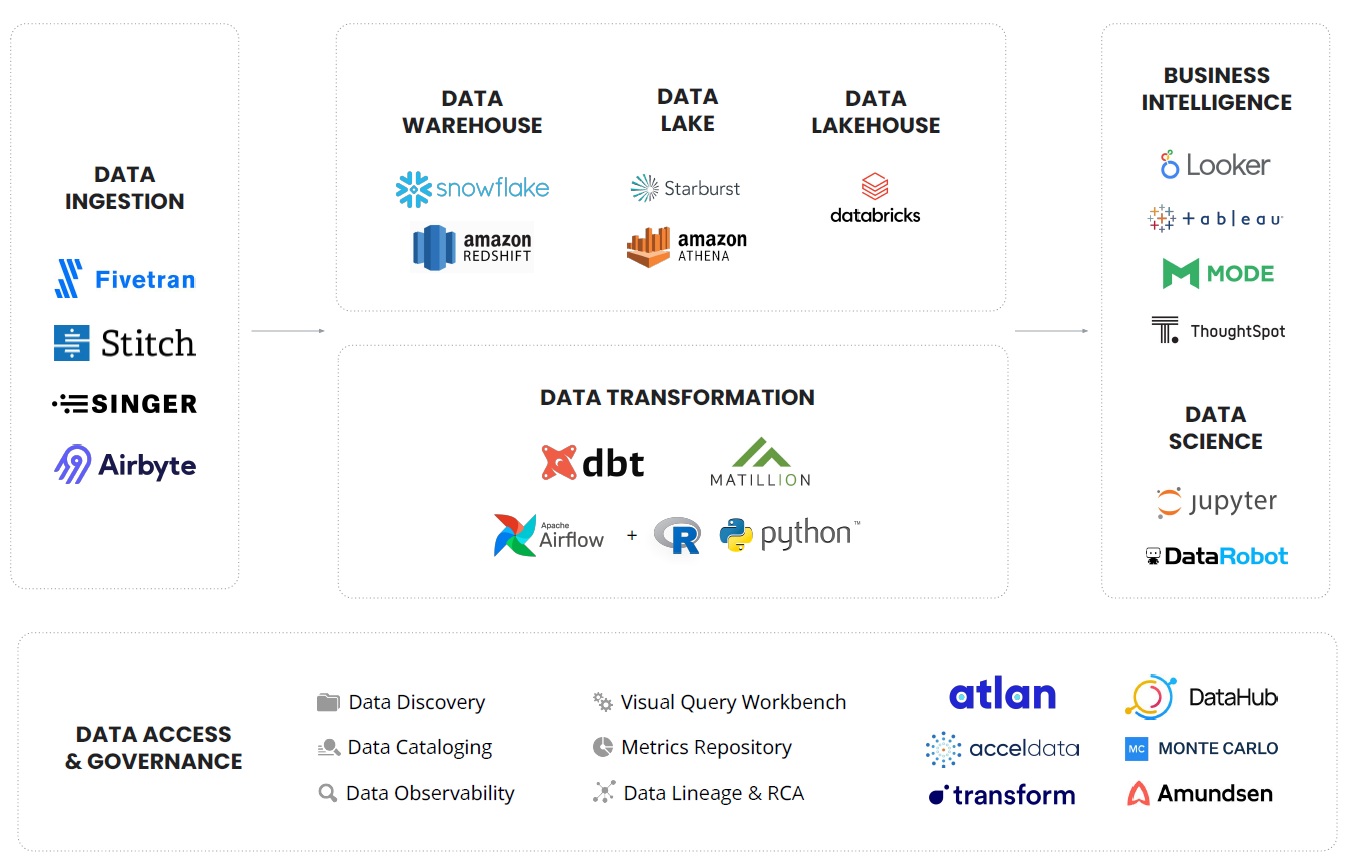
From Passive to Active Metadata
Data Catalog 1.0 — a static data dictionary. Someone writes descriptions, someone else reads them.
Data Catalog 2.0 — automated metadata harvesting. Crawlers scan sources and populate the catalog without manual input.
Data Catalog 3.0 — Active Metadata Platform — the catalog doesn't just store metadata, it uses it. Active metadata platforms trigger actions, propagate lineage automatically, surface recommendations, and feed governance policies back into the pipelines that produce data.
Key Capabilities of an Active Metadata Platform
- Automated lineage — tracks data movement from source to consumption without manual tagging
- Usage intelligence — surfaces which datasets are actually used and by whom
- Data quality integration — propagates quality scores from pipelines into the catalog
- Policy enforcement — classifies and applies governance rules at ingestion time
- Semantic layer — connects business terms to physical assets across domains
Where the Data Catalog Sits in a Data Mesh
In a data mesh, each domain publishes data products with defined contracts. The active metadata platform acts as the central registry for these products — providing the discovery surface, quality metrics, and ownership information that consumers need to trust and use data across domain boundaries.
Without a well-implemented catalog, a data mesh quickly becomes an ungoverned collection of silos. The catalog is what makes the mesh navigable at scale.